


HOME SWEET HOME—Thank you, Melbourne.
It was an awesome week with Netflix for the first-ever NFL regular-season game in Australia. I watched the Seahawks-Patriots kickoff game over breakfast. I almost started a fire in my hotel room by plugging an American blender into an (apparently incorrect!) adapter. I got chills listening to seemingly all 100,021 fans inside the Melbourne Cricket Ground sing along to “Advance Australia Fair.” I interviewed Sean McVay at dawn. I even ate a meat pie after the 49ers’ stars of the game left the whole plate untouched (their only loss of the day). And I was home in Minnesota by 1 a.m. Sunday, just in time to break the news on Myles Garrett’s knee surgery and then binge the first NFL Sunday in bulk.
Week 1 was a blur, to say the least. And just like that … we’re on to Week 2.
A couple of quick programming announcements: I’ll be doing our first live chat at noon ET this Sunday right here on Substack before kickoff of the early slate of games. We also recorded a new Ringer NFL Show on Friday to help kick off your weekend. This column is available in full to all subscribers. In the future, only paid subscribers will be able to access all the news and nuggets in The Sweep.
This dispatch is based on conversations with sources in and around the NFL.
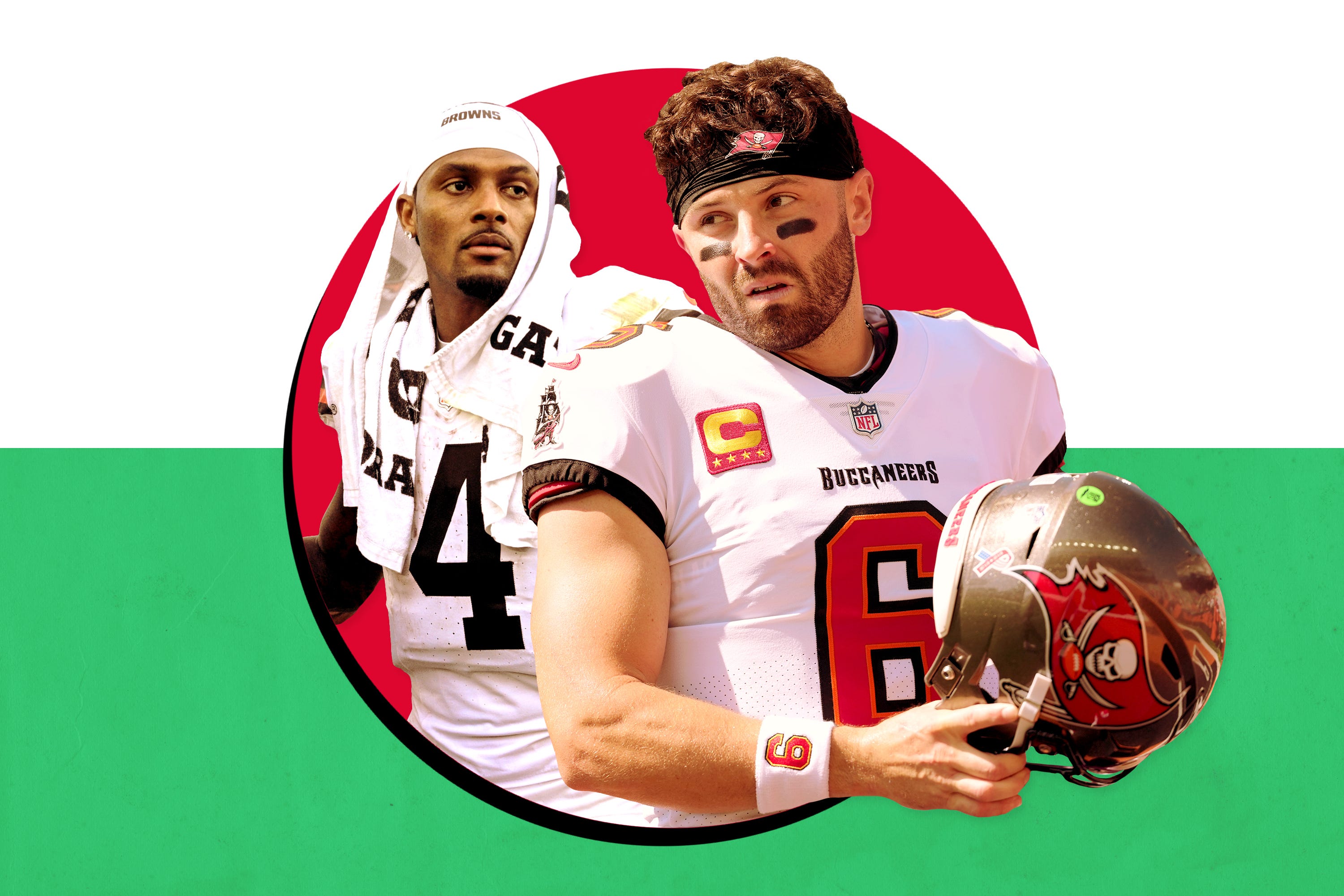
Deshaun Watson vs. Baker Mayfield: Fallout From the Trade That Rocked the NFL
It was March 17, 2022, and Baker Mayfield had heard enough.
The former no. 1 overall draft pick, who just a season earlier had led the Browns to their first playoff appearance in 18 years, was coming off a brutal 2021 season in which he played through significant left shoulder and knee issues and the team slipped to 8-9. But as the offseason began, Mayfield still believed he had the team’s word that he’d be back as Cleveland’s starting quarterback—until the Browns informed his agent at the NFL scouting combine in February that they intended to explore their options.
Soon the Browns were one of several teams involved in a wild and highly public pursuit of a trade for Deshaun Watson, whose agent informed the team on that March day that Watson wasn’t coming to Cleveland. The Browns had offered to fly to Texas to meet with Mayfield at his offseason home. But in Mayfield’s mind, the bridge had already been burned. Mayfield requested a trade; the team said no. He was still under contract for another season. And Mayfield may well have ended up playing for the Browns again that fall—and perhaps even now—if not for the events of the frantic hours that followed.
One day later, the Browns landed Watson in one of the biggest trades in NFL history and gave him a record-setting contract. Cleveland did it even though Watson had sat out the prior season for the Texans amid serious accounts of sexual misconduct, which were laid out in 27 civil lawsuits, while also facing the probability of a lengthy suspension from the league. Mayfield got his fresh start a few months later when the Browns traded him to Carolina—the beginning of a nine-month, four-team journey that led him to the Bucs. On Sunday, the two quarterbacks will play each other for the first (and perhaps only) time since those fateful days four and a half years ago.
It’s been so long that the memories of those involved in the trades were a bit fuzzy on certain details when I reached out this week to reconstruct the timeline of events. But everyone I spoke with agreed on this: Even without the benefit of hindsight, it was an unprecedented situation that would have unpredictable results.
To fully understand how it all went down, you have to go back to the 2020 offseason, when the Texans were in negotiations with Watson—then a 24-year-old star coming off consecutive playoff trips and two Pro Bowl selections. He was newly eligible for an extension and wanted to get paid as the QB market moved that offseason with new deals for draft classmate Patrick Mahomes and others.
Days before the 2020 season began, Watson and the Texans agreed to terms on a four-year, $156 million extension that topped the market in virtually every metric. It gave Watson a roughly $20 million raise over the two seasons remaining on his rookie deal, with another $72 million guaranteed for all practical purposes in the first two extension years.
Some on staff didn’t want to extend Watson at all—most notably then–executive vice president of football operations Jack Easterby, who had arrived from New England in 2019 with designs on resetting the building and immediately had friction with Watson. While often electric on the field, he was frequently late to meetings, wanted increased influence over personnel and coaching decisions, and had trouble correcting some on-field shortcomings, such as a cadence that coaches felt was contributing to pre-snap penalties. But owner Bob McNair and his family weren’t going to let go of a promising young star they’d traded up 13 spots to get at no. 12 in the 2017 NFL draft.
It didn’t take long for it all to unravel.
The Texans fired coach and general manager Bill O’Brien after an 0-4 start in 2020. Watson wanted a say in the search for O’Brien’s replacements; Easterby pushed back. Weeks after Houston hired Easterby’s former Patriots colleague Nick Caserio as GM in January 2021, Watson formally requested a trade. The first of the 27 civil lawsuits against Watson was filed in March 2021, and the NFL opened a personal conduct policy investigation. Still on the Texans roster when training camp began in July, Watson awkwardly went through individual drills and stood in as a scout-team safety in walkthrough before coming to an agreement with Caserio that it would be best for everyone if he were inactive for every game that season. The Dolphins were the only team to show serious interest in acquiring Watson during the season, and even then, communication between the two teams was limited. Dolphins owner Stephen Ross received permission to speak with Watson shortly before the November trade deadline, but it was too late to work out a complicated trade, pushing the situation into the following offseason.
Despite the unresolved civil suits, the probability of a lengthy suspension, and the fact that Watson had spent a year away from football, several suitors emerged after the 2021 season. And things really ramped up on March 11, 2022, when a Texas grand jury declined to charge Watson with any crime. (A second grand jury did the same later that month.)
From there, Caserio set the ground rules: He had set the minimum criteria that he’d consider for trade compensation, and any team that wanted permission to speak with Watson needed to agree they’d meet it. Four teams—the Panthers, Saints, Falcons, and Browns—agreed to those terms, and high-ranking members of each organization met with Watson the week of March 14.
At that point, the leverage shifted to Watson’s agent, David Mulugheta. Not only did Watson have a no-trade clause, this essentially was no longer a trade—this was more like free agency, and Mulugheta could seek the highest bidder on a new contract to replace the extension that technically hadn’t even started yet. While Caserio told the other teams they didn’t have permission to negotiate a new contract for Watson unless and until they agreed with the Texans on exact trade terms, the word was out: If you want Watson, you have to pay him, too.
For Watson’s part, he felt the Browns had the best roster of the interested teams. He was reluctant mainly because he’d be playing home games in a cold-weather climate for the first time in his life.
While the exact sequence of events depends on who you ask, many of those involved recall believing the Falcons were the team to beat—especially once word leaked that Mulugheta had told the Browns that Watson wouldn’t be coming to Cleveland. Falcons tight end Kyle Pitts (another Mulugheta client) even tweeted and then deleted a post saying, “It’s about to get scary in Atlanta.” But Falcons officials watching the situation unfold in the building and at dinners with free agents increasingly had a feeling that Watson was headed elsewhere.
Just one day after they were told they were out of the running for Watson and Mayfield’s trade request went public, the Browns landed their new QB for an extraordinary price: Not only a boatload of picks that included first-rounders in the 2022, 2023, and 2024 drafts, but also a five-year, $230 million contract that was fully guaranteed at signing. (If valued as an extension, the new money would’ve checked in at a record $94 million for one year.) The deal was so out of step with NFL norms that one longtime executive for a different team told me that day of the Browns: “They just changed the whole landscape of economics of the NFL.”
Meanwhile, Mayfield was in a bind: No one was eager to trade draft assets for an undersized QB with no future in Cleveland who was coming off an injury-plagued season. (Some front office executives privately grumbled they had no interest in helping out the Browns after the Watson contract, though Cleveland had no trouble making other trades that offseason.) It wasn’t until Fourth of July weekend that talks accelerated with Carolina, which sent a conditional pick that ended up being a fifth-rounder to Cleveland for Mayfield.
What happened in the four-plus years since is well documented: Watson has played just 20 games for Cleveland. He served an 11-game suspension in 2022 and was fined $5 million for violating the personal conduct policy. He battled shoulder problems during the 2023 season, ultimately undergoing season-ending surgery for a displaced fracture that November. He tore his right Achilles in October 2024 and suffered a second tear to the same Achilles while still in the rehab process a few months later, sidelining him for the entire 2025 season. Now 31 years old and in the final year of that deal, Watson was booed by the home crowd during a preseason game last month. New coach Todd Monken nonetheless named him the starter; Watson was 16-of-22 passing for 205 yards with a touchdown and an interception in last week’s 34-10 loss at Jacksonville.
Meanwhile, Mayfield—after six starts with the Panthers, who benched him multiple times before cutting him, and a brief revival with the Rams—took a chance on a one-year, $5 million deal to succeed Tom Brady as the Bucs’ starter in 2023, and has been there ever since. Last week, he signed his second extension, a three-year, $165 million deal that runs through 2029.
The questions that linger about the Deshaun Watson trade are less about the Browns’ thought process than that of the rest of the league. After all, why were not just one but several teams willing to seriously consider gambling their future on a highly talented, albeit flawed, player who was facing serious allegations and the strong probability of a lengthy suspension?
Look no further than how things have played out for those same four teams in the years since. All are still searching for answers at the most important position—and in many cases, the staffs that pursued Watson have already run out of time to find them. None of the five teams that showed the most serious interest in Watson have the same head coach that they did in 2022, and four of the five teams have new GMs.
The Dolphins called off their pursuit of Watson after the firing of coach Brian Flores and hiring Mike McDaniel, who turned Tua Tagovailoa into one of the NFL’s most efficient QBs when healthy. In July 2024, Miami signed Tagovailoa to a four-year, $212.4 million despite a lengthy injury history; barely two years later, the Dolphins have yet another new head coach and GM, who cut ties with Tagovailoa in March. Tagovailoa is still making nearly $53 million cash this season from Miami and he’s being paid the veteran minimum salary from Atlanta, while the Dolphins’ new regime signed Malik Willis to a bridge contract. Miami may very well draft another QB as soon as 2027. The Dolphins made the playoffs twice in four seasons under McDaniel, who was fired in January months after the team parted ways with GM Chris Grier, but they haven’t won a playoff game since January 2000.
The Falcons informed former NFL MVP Matt Ryan before intensifying their pursuit of Watson—a decision that everyone understood as the beginning of the end for a franchise legend, who was ultimately traded to the Colts for a second-round pick. Atlanta is 30-39 with no playoff trips since and has started six different quarterbacks, including 2024 first-round pick Michael Penix Jr. With coaches Arthur Smith and Raheem Morris gone as well as GM Terry Fontenot, Ryan is back with the organization as their president of football; the organization is still trying to find a franchise QB. Penix is recovering from his latest torn ACL and Tagovailoa suffered an oblique injury last week in practice, leaving third-stringer Cooper Rush to make his second straight start Sunday against Carolina.
The Panthers took multiple big swings at QB, including a push for Matthew Stafford in 2021 before the Lions traded him to the Rams. After their pursuit of Watson, the Panthers ended up with Mayfield and Sam Darnold on the roster in 2022. But they reset after the season with a new coach and traded up for the no. 1 pick in the 2023 draft to take Bryce Young. (Frank Reich, who had replaced Matt Rhule, lasted just 11 games as Young and the offense struggled. General manager Scott Fitterer was fired after the 2023 season.) After an early-season benching by Dave Canales in 2024, Young returned to action and has turned the arrow upward, leading Carolina last season to its first playoff berth since 2017. Contract talks this past offseason didn’t go far, likely pushing a decision about committing to him as the franchise’s future until 2027.
The Saints have started eight different quarterbacks since Hall of Famer Drew Brees’s retirement after the 2020 season, turning to Jameis Winston in 2021—Sean Payton’s last season before stepping down as coach—before pursuing Watson. They ended up signing Andy Dalton in 2022 and then Derek Carr a year later. They also gave a long look to fifth-round draft pick Spencer Rattler before finally landing a QB they hope might be their man: Tyler Shough, a 2025 second-round pick who gave life to the offense down the stretch as a rookie last season. Kellen Moore replaced Dennis Allen as head coach in 2025; the Saints still haven’t made the playoffs since Brees’ final season.
The Browns went with Watson as the starter this season over 2025 fifth-round pick Shedeur Sanders, who figures to get another opportunity at some point in 2026. They also have 2025 third-round pick Dillon Gabriel (who is currently on IR) and 2026 sixth-round pick Taylen Green on the roster. And they own two 2027 first-round picks to potentially target their next QB. Quarterbacks aside, their 2025 draft class was one of the NFL’s best, providing a foundation of young talent for a franchise that seemingly has been seeking a franchise QB since the NFL returned to Cleveland in 1999. The Browns fired Kevin Stefanski at the end of last season and replaced him with Todd Monken; GM Andrew Berry remains. Watson has been paid almost all his cash from his historic deal, but he’ll still count toward their cap for two more years. Barring an extension, he’ll be a post–June 1 cut in March, spreading his dead cap hit over the 2027 and 2028 seasons.
Meanwhile, the Texans used the windfall from the Watson trade—both picks and salary cap relief—to remake their roster into the team that has made the divisional round of the playoffs three years in a row. Other decisions spearheaded by Easterby and Caserio, such as the DeAndre Hopkins trade to Arizona in 2020 and the release of J.J. Watt in 2021, were widely panned by fans and media at the time. But they also helped clean up Houston’s books, replenish draft assets, and catalyze the turnaround. If you can survive the pain—Caserio did; Easterby and multiple coaches did not—a full reset like that is worth the gain, provided you use all those assets wisely.
The Texans hired DeMeco Ryans in 2023 and also might have their QB: They drafted quarterback C.J. Stroud one pick after Young in the 2023 draft and made a run at extending him this offseason before the sides agreed to wait until next year. What was a $40 million QB market in 2022 is now a $60 million market and rising, complicating efforts to get deals like this done.
Stroud’s agent? David Mulugheta.
What Is Porter’s Plan?
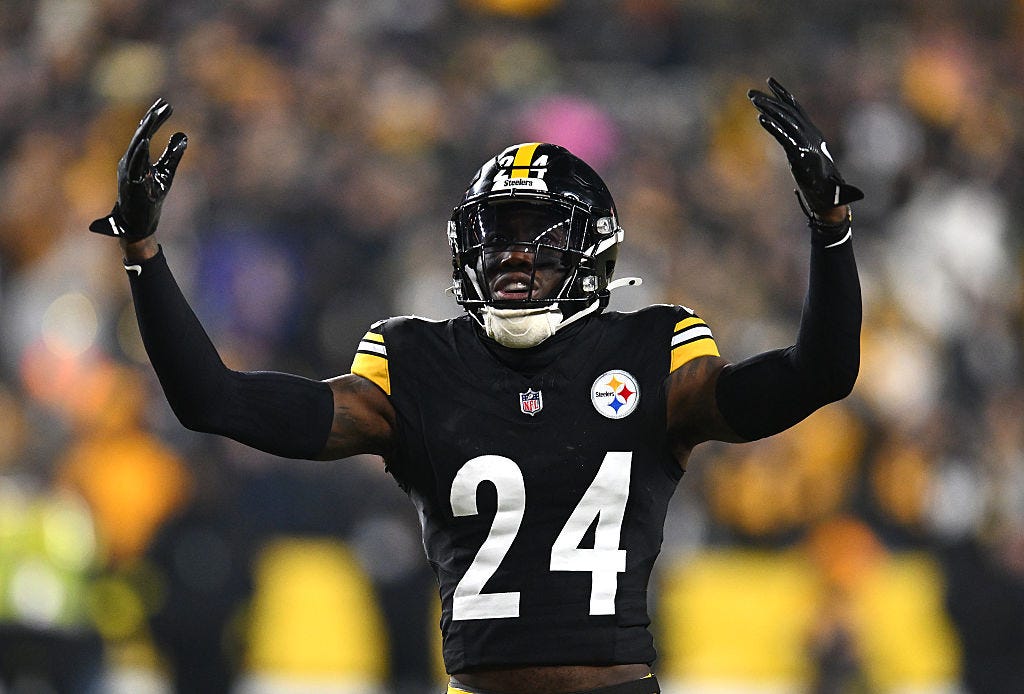
The Steelers ruled out cornerback Joey Porter Jr. again for Sunday’s game at New England, capping a strange week in which Mike McCarthy said Porter would fully participate in Wednesday’s practice, the team ended up listing him as limited for “conditioning,” and then Porter left Thursday’s practice after he said he tweaked his back again.
There’s no doubt Porter wants to get paid after watching the cornerback market explode this offseason, and his ongoing back tightness provides a convenient out from participating until he does. There also are no signs the Steelers intend to break with longstanding organizational policy by resuming contract negotiations in-season with Porter, who is due $3.924 million in the last year of his rookie contract. So, that leaves three options: Porter plays out this season on his existing deal in Pittsburgh, another team trades for him, or he doesn’t play at all.
Remember, Porter barely practiced in training camp. If he’s at risk of reinjury or just not ready to play like himself, having him on the field wouldn’t make sure for either side. At this point, nobody is ruling out a return for the Steelers’ game next week against Cincinnati. Given all the headlines, GM Omar Khan’s phone surely has started to ring, and nobody should rule out the possibility Porter’s next game is in another uniform, either.
Good Decisions, Bad Results
Packers coach Matt LaFleur’s decision to take three points off the scoreboard and go for fourth-and-1 with a five-point lead and over 13 minutes to go in regulation last week in Minnesota backfired. Jordan Love got stuffed on a QB sneak, turning the ball over to the Vikings on downs. But multiple game management coaches with other NFL teams that I consulted agreed that, mathematically speaking, LaFleur had made the right call.
Last season, NFL teams converted 65.7 percent of the time on fourth-and-1 (nearly two out of every three attempts). If the Packers had converted, they could’ve either driven for a touchdown to make it a two-score game—cutting the Vikings’ win probability in half—or run more time off the clock before kicking another field goal. Declining the penalty and taking an eight-point lead would’ve made sense if there were only time for the Vikings to have one more possession. But there was far too much time left to think that way.
Bottom line: good decision, bad result.
The math was also in the Saints’ favor when Kellen Moore opted to go for a two-point conversion and the win last week in Detroit, rather than a tying extra point in overtime.
Even though teams converted two-point conversions at only a 46 percent clip last season, kicking the extra point would’ve amounted to playing for a tie. The Lions still would’ve had 94 seconds to drive for a game-winning field goal, a far more likely outcome than the chances of New Orleans forcing a turnover in field goal range to win the game instead.
The Lions covered Shough’s first option and his throw to the back of the end zone fell incomplete, sealing a Detroit win. But Moore said he stood by his decision to go for the win, and it’s hard to imagine him doing differently next time.
Two-Sentence Drill
It’s a highly unusual play, but there was no rule change contributing to Jared Goff’s fumble being overturned in last week’s win over the Saints, taking a New Orleans fumble off the board. The NFL’s replay center is looking for the passer to already be in the passing motion before defensive contact and the quarterback’s hand coming forward with control of the ball; Goff met both criteria, so by rule, it was a forward (and incomplete) pass.
The Packers are not expected to be disciplined for working out DT Zxavian Harris one day before the league sent a memo clarifying that Harris and TE Dae’Quan Wright are ineligible to try out, visit, or sign with any NFL team during the 2026 season after attempting to return to college football and play for LSU. The NFL Players Association is looking into exactly what Harris, Wright, and any other potentially affected player did individually; the possibility of a grievance is still on the table.
Tests showed Chiefs CB Mansoor Delane, who exited Monday’s win over Denver after recording an interception on the opening drive, suffered a low-grade AC joint sprain. Essentially this is the best-case scenario for the no. 6 draft pick, who was limited in practice Friday and is officially listed as questionable for Sunday’s game vs. the Colts.
Fantastic review of the DeSahaun Watson debacle in Cleveland. Man, I had totally forgotten that the Panthers had both Baker Mayfield *and* Sam Darnold on the roster and left them both leave.