


SOMEWHERE OVER THE PACIFIC—I have no idea what day it is.
I connected through San Francisco on Sunday, and at some point crossed the international date line before landing Tuesday in Melbourne, Australia, site of the Rams-49ers opener that I’ll be working for Netflix on Thursday night … errr, Friday morning.
The scene should be wild: An NFC West showdown in a 173-year-old cricket stadium that holds more than 100,000 fans, many of them sure to join the party several hours before kickoff. During the game, I’ll be working the Rams sideline, chronicling the prohibitive Super Bowl favorites as they begin in earnest what they hope will be a journey home to Super Bowl LXI in Los Angeles.
You know the scene in Back to the Future when there are two Marty McFlys watching the terrorists shoot Doc Brown? (Nooooo! Bastard!) That’ll be me living Saturday twice on my way home, hopefully without returning to an altered reality in which everyone else has changed and nobody really explains what happened to the other me who lived there before.
Anyway, I’ll be like you on Sunday: Watching the bulk of the Week 1 slate on the couch. We’ll break it all down Monday on The Ringer NFL Show. But first, let’s empty the notebook on some of the biggest stories of the offseason and what’s to come.
The first of my weekly dispatches here at The Sweep, like all those to come, is based on conversations with sources in and around the NFL.
How Do the Rams Keep Getting Away With It?!
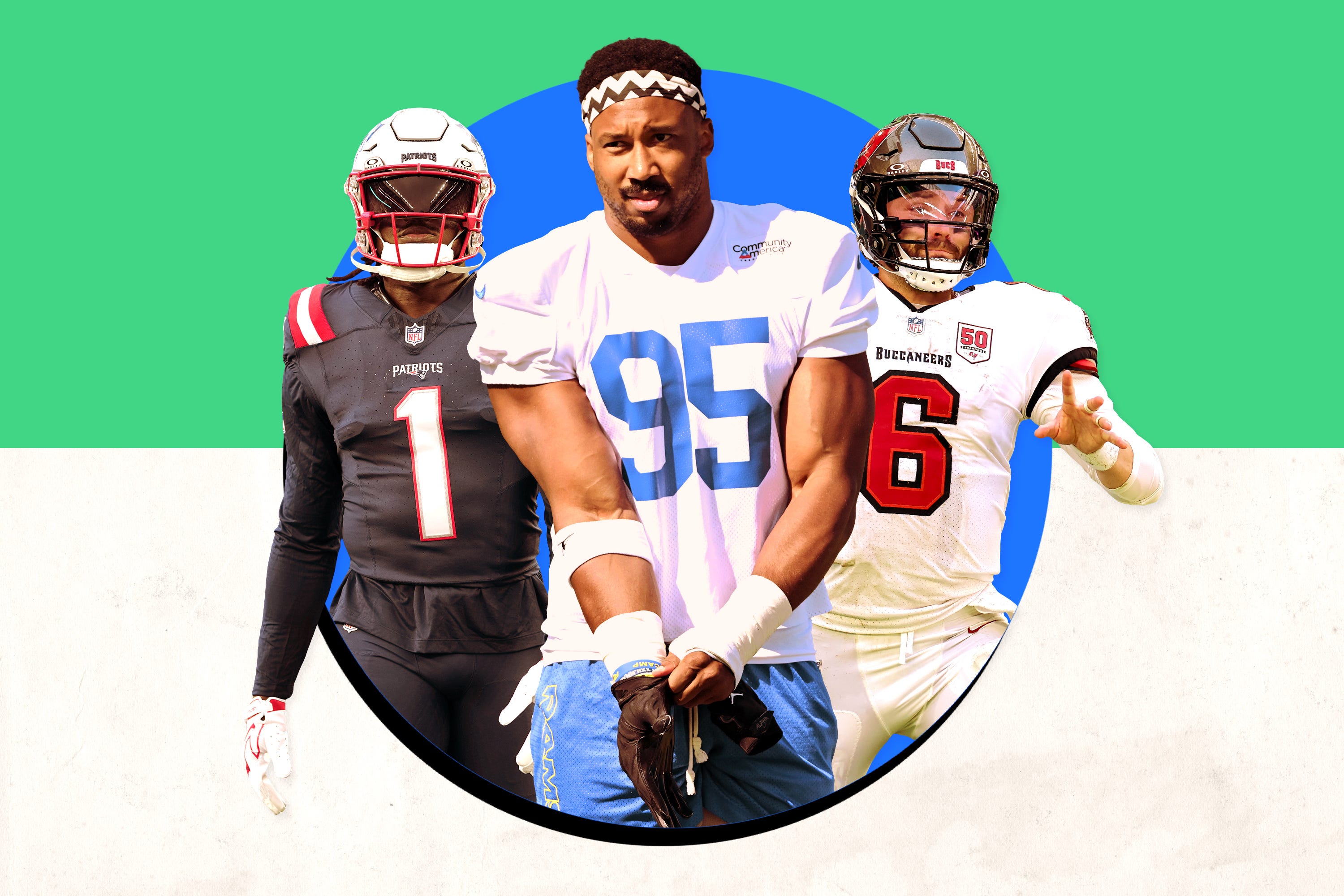
There’s no such thing as “cap magic,” even in an offseason when it might have seemed like the Rams were untethered from any financial restrictions. They traded for cornerback Trent McDuffie from the Chiefs and signed him to a record contract, signed free agent cornerback Jaylen Watson (also from the Chiefs), gave quarterback Matthew Stafford a raise, traded for Defensive Player of the Year Myles Garrett … and still had the ability to lure Aaron Donald out of retirement.
To understand how the Rams operate, let’s start with two basic principles of the salary cap:
Every dollar you spend hits the cap eventually.
Any cap space you don’t use in a given year can be rolled into the future.
Those factors tend to lead to cyclical spending. One of the secrets to the Rams’ team-building philosophy is they’re financially disciplined and honest with themselves about how close they are to competing for a Super Bowl, and that informs their decisions about when to lean into the moment and go big.
Over the first five years of the current collective bargaining agreement (2021-25), the Rams ranked 32nd out of 32 teams in cash spending on player salaries. After winning the Super Bowl the first of those years, they ran it back with mostly the same roster and cratered to 5-12 in 2022. The following offseason, they shed veteran contracts by cutting players like Bobby Wagner and Leonard Floyd and trading Jalen Ramsey, and ate more than $79 million in dead cap. In 2023, they had 14 draft picks make the team and entered the season with the NFL’s second-youngest roster.
When young, cheap players outperform expectations, a team can get good quickly while conserving spending power for later. In a league where most teams now spend cash over cap (using prorated signing bonuses to push most of the cap impact of big contracts into the future), the Rams actually spent $120 million cash under cap from 2023 to 2025.
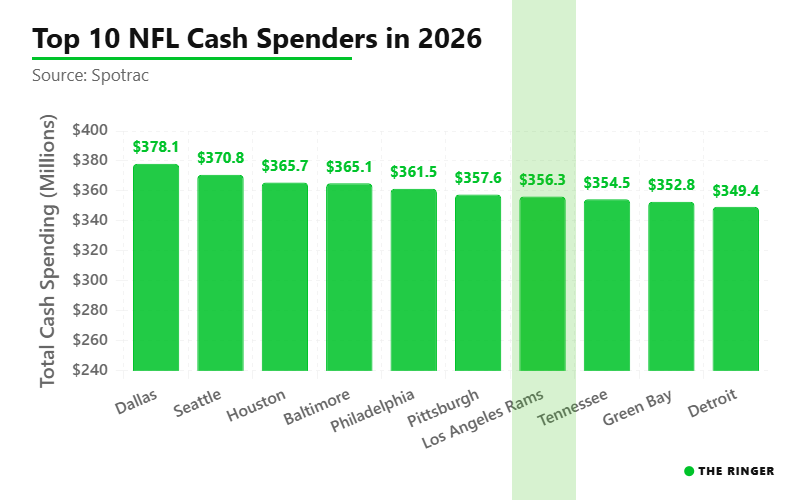
In a way, they were filling the piggy bank for this moment: The Rams’ $357 million in projected cash spending for 2026 ranks seventh (and they are only about $9 million behind the Texans, who are in third), and they are well over both the league cap of $301.2 million per club and their own adjusted cap of about $316 million. And because the Rams have yet to extend newly eligible members of their vaunted 2023 draft class—a list that includes star receiver Puka Nacua, standout front-seven players Kobie Turner and Byron Young, and starting offensive linemen Steve Avila and Warren McClendon—they’re still in the bottom quartile of the league in committed cash in future years with around $220 million guaranteed, much of that owed to McDuffie, Garrett, and Stafford, who is 38 and remains on a year-to-year plan.
Other teams are wondering what the Rams’ strategy is with those young players, given that waiting to do deals generally drives up their price. There are some no-brainers here, such as re-signing Nacua after this season, provided one of the NFL’s top pass catchers learns from his mistakes after a turbulent past year. But if they win it all, will the Rams double down on an older roster, which would mean letting some of those promising young players walk and then using compensatory picks to backfill? If Stafford doesn’t return next season, could they completely reset, go with first-round pick Ty Simpson at QB on a cheap rookie deal, and keep the young core together?
It’s too soon to say how it’ll play out. But after all the splashy moves this offseason by a franchise that never shies away from zigging when others zag, the Rams still have optionality and are positioned to adapt to whatever circumstances dictate six months from now.
The Other Myles Garrett Suitor
The Rams were the only team the Browns negotiated with before trading Garrett, who went to L.A. in exchange for three high draft picks1 and Jared Verse on June 1.
But sources say another team called Cleveland on the day the trade leaked: The Bills, who had checked in periodically on Garrett’s availability for the better part of two years. Previously, the answer had always been the same: Myles Garrett is not available. Even if the Bills would’ve matched the draft pick compensation in the Rams’ trade package—and talks never got there—they couldn’t offer to trade a young edge player on a rookie contract such as Verse, whose inclusion in the deal was pivotal in getting the Browns to relent and move the reigning NFL Defensive Player of the Year.
Maxxed Out
Garrett wasn’t the only superstar edge the Rams strongly considered acquiring in the spring.
They also called and kept tabs on Maxx Crosby, who ended up back in Las Vegas after a blockbuster deal with the Ravens came apart in March over concerns about the knee Crosby had repaired in January.
Crosby took the failed trade as a sign from the universe that he was meant to be in Las Vegas—a city he never wanted to leave in the first place. It was the constant changes, losing, and general chaos that had him frustrated. Everything has seemingly calmed down under Klint Kubiak and his staff (it helps that Crosby’s former position coach Rob Leonard is the new defensive coordinator), and Crosby has reiterated in interviews this summer he wants to be a Raider.
Does that mean Crosby is in Vegas to stay? Put it this way: If he looks like Maxx Crosby again (and so far, sources say, he looks great), GM John Spytek’s phone will be ringing before the November 10 trade deadline and everyone will have decisions to make. Again.
Checking in on A.J. Brown
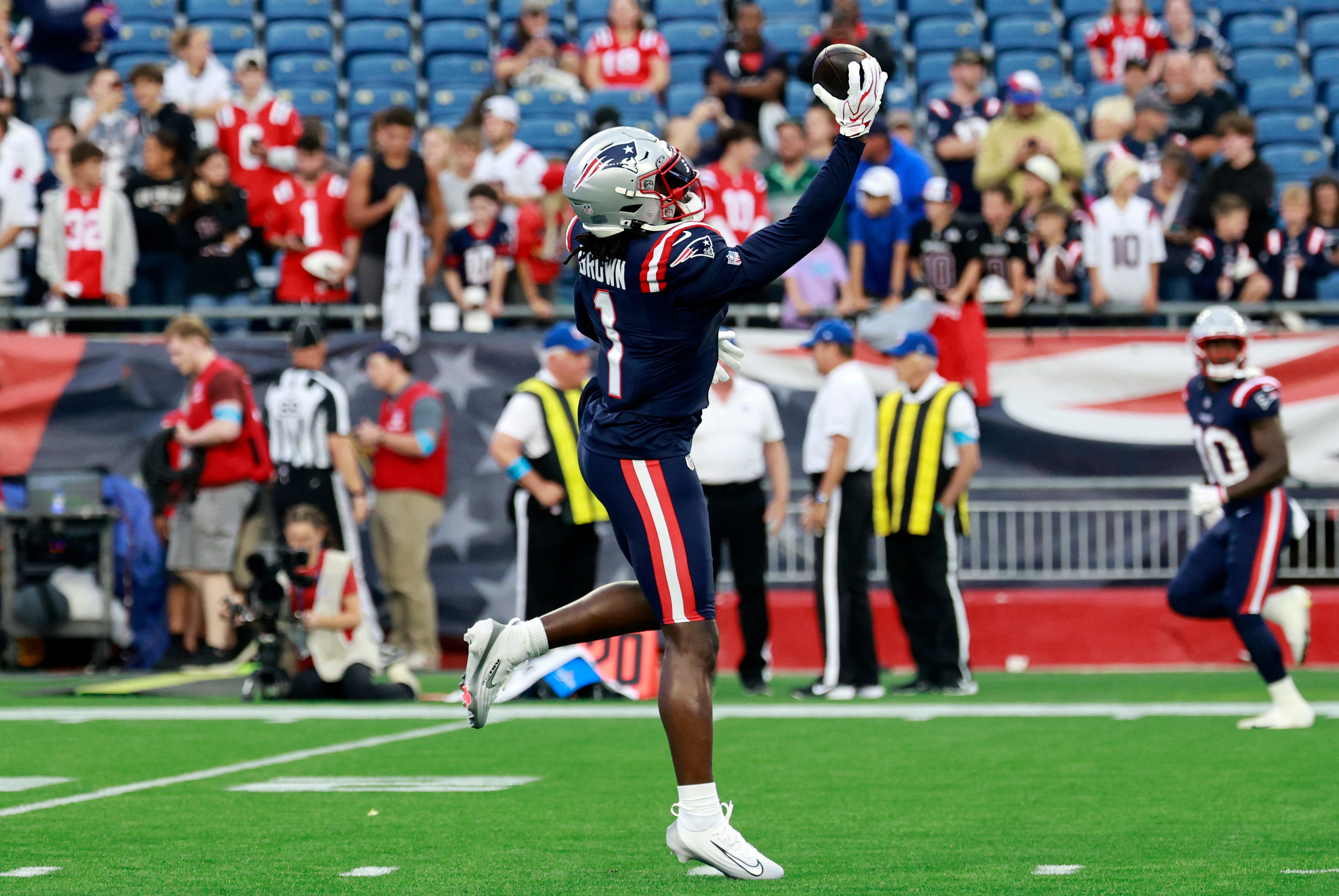
The Rams—yes, them again—also explored a trade for receiver A.J. Brown in the spring. Brown was eventually dealt from Philadelphia to New England for a 2028 first-round pick and a 2027 fifth-rounder.
It’ll be interesting to watch how the Patriots integrate Brown into their offense—and how much they get him the ball after his usage dropped in Philadelphia last season. After so much drama surrounding his relationship with Jalen Hurts and the buildup to Brown’s Eagles exit, Brown will need to control his emotions during his Patriots debut in Wednesday’s kickoff game at Seattle and not try to force the chemistry with his new quarterback, Drake Maye.
At age 29, Brown is nearly four years younger than the since-departed Stefon Diggs, who played over half his limited snaps in the slot for the Patriots last season. Brown brings a big, physical presence on the perimeter and he can still wreak havoc if defenses try to play him one-on-one. The Patriots also added free agent receiver Romeo Doubs, so now, Patriots play caller Josh McDaniels has a versatile group he can move around to create mismatches.
Arms Away in Super Bowl Rematch
A lot was made before Super Bowl LX about Maye’s throwing shoulder, which he injured in the AFC championship game and which required a shot before Super Bowl kickoff. That injury may well have affected him in a disappointing offensive showing against the Seahawks. But we probably didn’t talk enough about what Sam Darnold was going through on the same field.
Darnold popped up on the Seahawks’ injury report with an oblique issue two days before Seattle’s divisional playoff game against San Francisco. The injury was significant enough that the Seahawks were preparing for backup Drew Lock to take his place. Darnold didn’t even throw in pregame warmups. But he made that start and two more, finishing the postseason with five touchdown passes and no interceptions.
Darnold’s injury—which sources say was diagnosed as a Grade 1 external oblique strain—is a tricky and sometimes painful one for a thrower in any sport. He spent the rest of the playoffs, all the way through the Super Bowl, working through a rehab progression while simultaneously preparing for the biggest games of his life.
In June, Darnold told the Bussin’ With the Boys podcast that he was “kind of bummed” by how the Seahawks won the title, because he thought that he didn’t play well against New England. The injury surely didn’t help. Tonight’s kickoff game should be a fun reminder of what both QBs can do at 100 percent.
The Bucs Bet on Baker
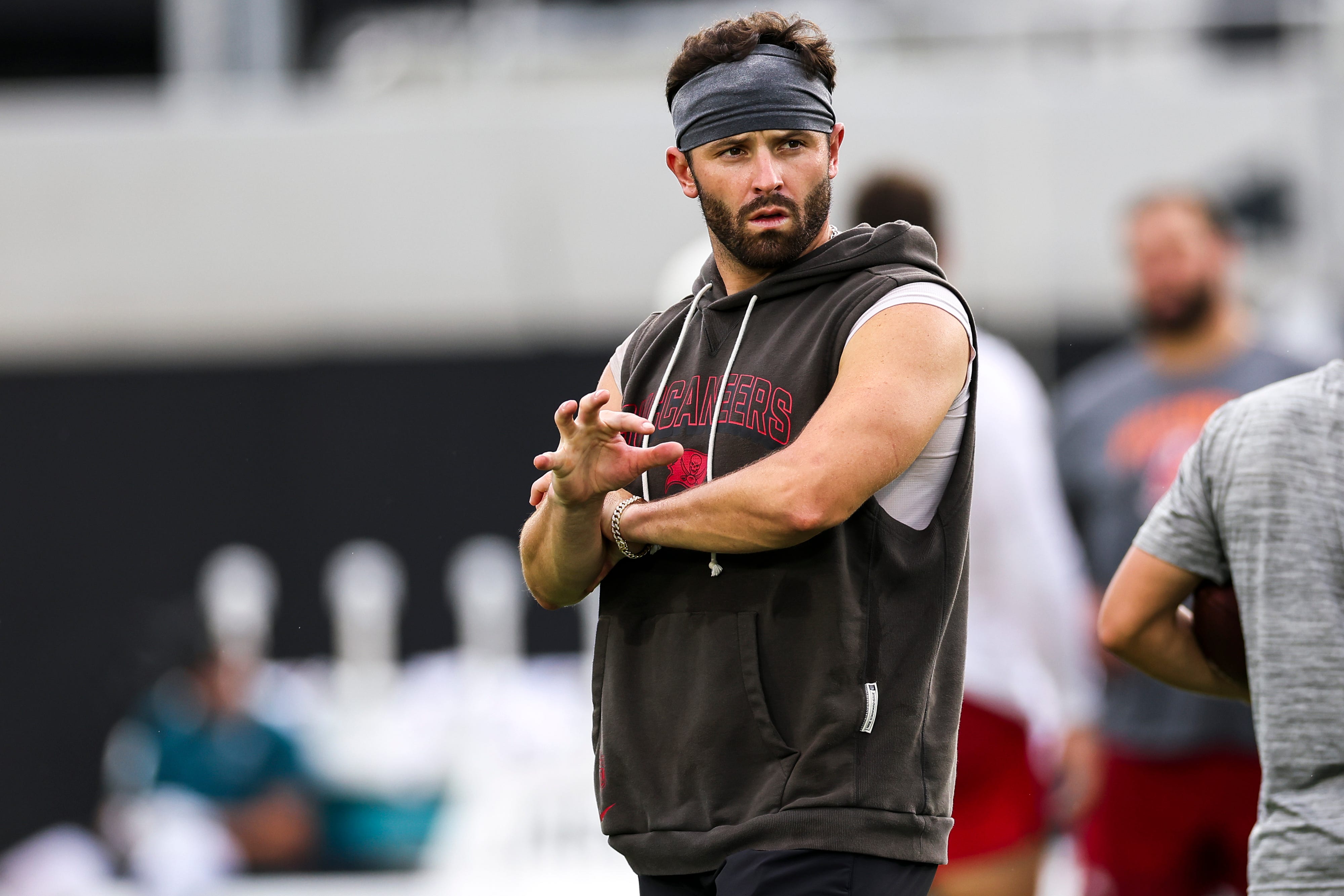
Baker Mayfield’s three-year, $165 million contract extension was a win-win for him and the Bucs. The sides re-engaged Sunday night, working toward an agreement that really wasn’t that far off when talks broke down ahead of Mayfield’s self-imposed deadline of the start of training camp in July.
For Mayfield, he gets the $55 million annual average he had been seeking all along, putting him in line with the players he considers his peers, such as Jacksonville’s Trevor Lawrence and Green Bay’s Jordan Love. He’ll make $100 million guaranteed over the next two years and has a chunk of his 2028 compensation guaranteed as well. And Tampa Bay agreed to add another year to the extension to get it done.
For the Bucs, they lock up a player they love at a number in line with other franchise QBs. They also avoid a potential doomsday scenario if they’d needed to tag Mayfield after the season. The one-year franchise tender would’ve been worth $48 million to $50 million cash, and Mayfield’s unamortized bonus proration would’ve accelerated into next year, creating a massive cap hit close to $80 million in 2027.
Mayfield had been one of the NFL’s best bargains since he arrived in Tampa on a one-year, $4 million deal to succeed Tom Brady in 2023. He re-signed on a three-year, $100 million deal in 2024—a deal that on Monday ranked him 16th in average annual salary among QBs, and last among those not on rookie or “bridge”-type deals. (New Dolphins starter Malik Willis ranked 17th at $22.5M APY.)
Mayfield’s size, personality and playstyle aren’t for everyone. But his stats and durability, while playing for a different coordinator each season he’s been in Tampa, puts him in the conversation with the other $50 million quarterbacks. And he’s still in his prime at age 31. Other than one day of venting his frustrations about his lack of a deal publicly, he was great in the Bucs building throughout camp—in spite of the contract uncertainty.
Now days before his fourth season in Tampa kicks off, Mayfield is finally getting paid like a legit franchise QB, and the most fascinating character in the free agent drama next March is already off the board.
Quarterback Market Mayhem
By next summer, Mayfield’s contract could look like a bargain again.
It’s difficult to get QB deals done at the moment in large part because everyone from teams to agents knows that the market will shift, perhaps drastically, in the next six to 12 months.
The Ravens continue to push for an agreement on a contract extension with two-time NFL MVP Lamar Jackson, who is signed through 2027. The top two picks in the 2023 draft, Bryce Young and C.J. Stroud, have not yet signed extensions. And there’s a talented group of QBs from the 2024 draft—featuring Caleb Williams, Jayden Daniels, Maye, and Bo Nix—who will become extension-eligible after this season. And some other players who have signed second deals in recent years could be in line for adjustments, especially considering that the salary cap has gone up by $76.4 million per club in just three years.
There are different ways to slice the numbers. For example, whether you see Josh Allen’s 2025 deal as a new six-year, $330 million contract, as the Bills did, or as a two-year, $200 million “new money” extension depends on your point of view. But the bottom line is that a $60 million QB could easily become a $70 million QB by next summer, providing added incentive for players to wait to sign if they don’t feel they’re getting their fair share now.
Nine Back
Fifteen trades were finalized on the August 30 roster cutdown day. None of them involved J.J. McCarthy, another member of that 2024 QB draft class.
Any trade of the Vikings QB, who lost the starting job to Kyler Murray in August, would’ve been difficult for many reasons, including the list of injuries that have limited McCarthy to 10 games over his first two NFL seasons and prevented him from building momentum on some promising moments. (See: Last season’s road win at Detroit.) The Vikings also had no intention of just giving away a 23-year-old quarterback for nothing, especially one who’s well-liked in the locker room and has gone 6-4 as a starter.
Here’s another factor: In a league in which eating money to facilitate trades has become commonplace, the Vikings had no way to pay down the roughly $4.85 million in guarantees remaining on McCarthy’s contract because the CBA prohibits teams from renegotiating a drafted player’s contract for three years.
Packer Problems
The Vikings open up against a Packers team without running back Josh Jacobs, who landed on the commissioner’s exempt list last week as he faces two misdemeanor charges related to his May arrest.
The league is conducting its own personal conduct investigation, and it’s impossible to predict when or whether Jacobs could come off the list. (His first court appearance was moved up from mid-November to this Thursday, potentially expediting a resolution that could allow the NFL to rule sooner rather than later on a potential suspension.) Time served on paid leave would be credited toward any suspension, with Jacobs ultimately paying back $566,667 for each game missed, plus losing a $41,176 roster bonus for each game he’s inactive.
For now, expect a backfield by committee with MarShawn Lloyd, Chris Brooks, and newcomer Kaleb Johnson, who have 116 NFL carries among them combined, running behind an offensive line that almost never practiced together in camp because left guard Aaron Banks and right tackle Zach Bako-Bewele missed substantial time.
What About Micah?
The status of Packers star edge Micah Parsons is also somewhat murky as he makes his way back from a late-December ACL reconstruction. As expected, he landed on the reserve/physically unable to perform list, meaning he’ll miss at least the first four games.
Green Bay is known as one of the most conservative teams medically in the NFL. But there is optimism that he’ll be back Week 6 against his old team, the Cowboys, and potentially even Week 5 against the Bears.
Two-Sentence Drill
The Falcons’ decision to name Tua Tagovailoa their Week 1 starting QB was no surprise, and it probably would’ve come sooner if Michael Penix Jr. hadn’t recently been cleared for 11-on-11 drills. Tua was better in camp than some of his preseason work shows, giving him an opportunity—at least while Penix is still making his way back from another ACL reconstruction—with a talented skill group around him to remind everyone why he has been one of the NFL’s most efficient passers for stretches of his career.
Despite Klint Kubiak’s delay in announcing his starting quarterback, the Raiders’ plan was always to roll with veteran Kirk Cousins while no. 1 overall pick Fernando Mendoza gets time to watch and develop. If Cousins plays well enough to stay in the lineup for the duration of the season, a fascinating situation looms in March, when Cousins’s two-year, $80 million option is scheduled to become fully guaranteed if he’s on the roster the fifth day of the league year, giving Las Vegas an exclusive window to keep, cut, or trade him.
No matter how Deshaun Watson’s latest shot to show he can play well and stay healthy goes, it’s a good bet Cleveland will keep him on the roster all season. The Browns believe Watson’s experience is valuable even if/when Shedeur Sanders replaces him as the starter, and Watson’s contract (like many of the Browns’ bigger deals) is structured to end in a post–June 1 designated cut for cap purposes—something that can happen only if he’s still on the roster in March.
With Mayfield staying in Tampa, the top billing in next year’s free agent class now could go to Kyler Murray, whose one-year minimum deal with the Vikings includes a no-tag clause, giving him control over his future. The Packers will get the first crack at answering a key matchup question for Minnesota opponents: How do you spy the elusive Murray, double-team Justin Jefferson, and make sure neither tilts the explosive-play battle?
A 2027 first, a 2028 second, and a 2029 third.
Excited about Sweep-Congrats!